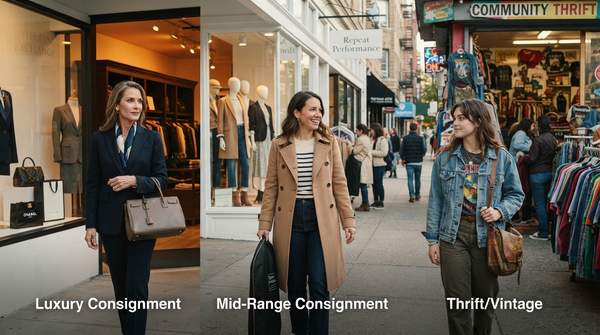
Consignment shops are not interchangeable. Industry guidance written for shop owners describes three broad models—luxury-focused, mid-range or brand-curated, and thrift-style—and each handles inventory, pricing, and acceptance differently. If you know which model your local store uses, you can predict whether your items will be accepted, roughly what they'll earn, and whether the racks hold what you want to buy. Here's how to read a shop before you walk in.
Understanding Consignment Shop Models
Writing for consignment-store operators, the software company ConsignCloud lays out the core distinction plainly: luxury-focused shops plan on individualized pricing for value, mid-range shops use a brand-tier guide or a "one-third rule" as a baseline with room for exceptions, and thrift-style shops keep pricing simple and low. The choice of model also reflects how the shop pays for inventory—in a consignment model, the store invests time in pricing because consignors share in the upside, while a buy-out model emphasizes speed and margin.
For you as a seller or buyer, these operational choices translate directly into consequences. A shop that prices each item individually is signaling high-value merchandise and selective intake. A shop that prices by category or tier is built for volume and speed. A directory listing for Buffalo, New York illustrates the practical stakes for shoppers: consignment stores are pickier and take branded, gently-used items, with prices running higher than thrift stores but savings of roughly 50–90% off retail, versus 70–95% at thrift stores.
Luxury-Focused Consignment: High Value, Individualized Approach
Luxury shops specialize in high-end designer brands, and their pricing method is the clearest tell. According to ConsignCloud, individualized pricing is "a necessity for any store selling luxury goods," and market-based pricing is the method of choice for luxury consignment shops, "where precision and competitive positioning matter most."
That means each item is researched individually. The store checks real-time resale demand, brand reputation, and trend status, comparing the piece against live listings and recent sold prices on platforms like The RealReal, Poshmark, Fashionphile, and eBay—rather than applying a flat retail percentage or tier list. Sandra and Tomas Weddle of Couture Upscale Consign use this method daily, per the same industry account.
For sellers, this model offers the potential for top-dollar sales and splits, but acceptance is strict: your item must be authentic, in excellent condition, and currently desirable. For buyers, it means a small, curated selection priced close to what the resale market actually bears.
Mid-Range & Brand-Curated Shops: Balanced Selection and Tiered Pricing
Mid-range shops focus on well-known, quality brands that aren't necessarily luxury but have strong resale potential. Their signature tool is the brand-tier system. One store owner cited by ConsignCloud, Alexandria Hammond of My Girlfriend's Wardrobe, uses a six-level pricing and acceptance system to sort brands by resale potential and quality, enabling quick decisions at intake.
Her tiers show how the logic works. Level 1 is "Do Not Accept"—consistently low-performing brands, such as lower-tier fast fashion or discount retailers, that would clutter the racks. Level 2 is "Filler Brands," accepted only selectively, typically when new with tags or to fill a size gap. Higher tiers carry premium brands with stronger resale value.
ConsignCloud notes that mid-range stores often blend approaches: individualized pricing for their higher-end inventory and a brand list for less expensive items. For sellers, that means your payout depends heavily on which tier your brand lands in. For buyers, it means a broader, more affordable selection than a luxury shop, with fast fashion largely screened out.
Thrift-Style Consignment: Volume and Simplicity
Thrift-style consignment shops prioritize high volume and lower price points. ConsignCloud's guidance for this model is blunt: keep pricing simple and low. Rather than researching each piece, these shops price by category or use formulaic approaches that move merchandise quickly.
This is still consignment, not donation-based thrift—the store sells your item and splits the proceeds—but the economics differ. Industry guidance on commission structures explains that higher-volume, lower-priced categories may justify a larger store percentage, because intake, tagging, merchandising, and selling consume a greater share of each transaction. The Buffalo directory's comparison captures the shopper's trade-off: thrift stores offer deeper discounts of 70–95% off retail, while consignment shops offer 50–90% with pickier, branded merchandise.
For sellers, thrift-style shops suit inexpensive, everyday items that a luxury or mid-range shop would reject. For buyers, they're the best bet for bargains, at the cost of a less curated experience.
Key Factors for Item Acceptance: Brand, Condition, and Seasonality
Three factors decide whether a shop takes your items. First, brand tier: as the six-level system shows, shops maintain explicit "do not accept" lists and premium tiers, with fast fashion and discount brands most likely to be turned away. The Buffalo directory reports the same pattern—most stores prefer well-known brands and classic pieces over fast fashion.
Second, condition. The directory describes the standard as quality items in excellent condition; the six-level system also accepts lower-tier brands selectively when they're new with tags, showing that condition can partially offset a weak brand.
Third, seasonality. Industry pricing guidance is direct: demand shifts throughout the year, and pricing should shift with it. Winter coats command stronger prices in October when buyers are actively shopping, but the same coat in January clearance moves only at a steep discount. Bring your items when shoppers are looking for them—this is inferred from the emphasis shops place on real-time resale demand and trend status, but the seasonal pricing evidence makes the timing consequence concrete.
Decoding Consignment Pricing: What Your Items Could Earn
Two pricing formulas dominate the industry. The percentage-of-retail method sets prices as a fraction of original retail, with benchmarks that vary by category. Industry guidance cites typical ranges: adult fast fashion clothing may start around 15–25% of retail, mid-tier clothing around 25–35%, and premium or designer clothing around 35–50%. A percentage that works for a blouse won't work for a handbag or sofa, which is why shops use category-specific benchmarks.
The second is tiered pricing—brand lists like the six-level system that let staff price routine merchandise without researching every item. Luxury shops skip tiers entirely in favor of market-based research.
Then comes the split. Industry guidance reports that for many resale businesses, the store keeps 50–60% of the selling price and the consignor receives 40–50%, with no universally correct split because labor, overhead, merchandise value, category, and store model all matter. The Buffalo directory reports the same 40–50% consignor range locally. A worked example from the industry guidance shows the math: if an item sells for $50 and the store keeps 60%, the store receives $30 and you receive $20; at a 50/50 split, each gets $25. Higher-value items like luxury handbags may support different splits because each sale produces considerably more revenue.
Consignment Shop Decision Framework
Use this matrix to categorize any local shop by cross-referencing what you observe—its inventory, how it prices, and what it accepts—against the three defined models. Once you've placed the shop, the final column tells you whether it fits your goals.
| Shop Model | Typical Inventory | Pricing Strategy | Acceptance Criteria | Best For |
|---|---|---|---|---|
| Luxury-focused | High-end designer brands and luxury goods | Individualized, market-based; each item researched against real-time resale demand and recent sold prices | Highly selective: authenticity, excellent condition, current market desirability | Sellers of authentic designer pieces seeking top dollar; buyers of curated luxury |
| Mid-range / brand-curated | Well-known quality brands with strong resale potential; fast fashion screened out | Brand-tier guides or hybrid: tiers for routine items, individual research for higher-end pieces | Excellent condition, preferred brands, seasonal alignment; explicit "do not accept" and premium tiers | Sellers of recognized mid-tier brands; buyers wanting balance of quality and price |
| Thrift-style | High-volume, wide variety at lower price points | Simple and low: category-based or formulaic pricing for fast turnover | Less selective than other consignment models, but still branded and gently used | Sellers of everyday inexpensive items; bargain hunters |
To apply it: browse the racks and note the brands. If you see designer labels with individually researched prices, it's luxury-focused. If you see organized mid-tier brands with consistent price points, it's mid-range with a tier system. If prices are uniformly low and selection is broad, it's thrift-style. Then check the intake counter's posted brand list or ask about acceptance rules to confirm.
Choosing Your Consignment Partner: A Strategic Decision
To maximize your consignment success, evaluate local shops by identifying their business model—luxury, mid-range, or thrift-style—based on their inventory, pricing methods, and acceptance policies, then match this to your specific items and selling goals. A designer handbag belongs at a market-based luxury shop; a mid-tier brand item fits a tiered mid-range shop; everyday pieces fit thrift-style volume sellers. Time your drop-off to the season, and confirm the split percentage before consigning, since the reported 40–50% consignor range varies by store and category.
A successful match is indicated by your items being accepted, priced appropriately for their value, and selling within a reasonable timeframe, or by consistently finding the types of items you seek as a buyer. If a shop rejects everything you bring or your accepted items sit unsold past a season, that's your signal the model didn't fit—and the framework above tells you which type to try next.
Sources
- How to Price Consignment Inventory Part 3: Your Pricing Method — Consigncloud
- 10 Best Consignment Shops Near You in Buffalo, NY — Consignment Shops Directory
- How to Price Consignment Items for Resale — Simpleconsign